
The Intersections of Integrity, Science, and Podcast Hosts
I do not want young men to look to Huberman and believe that the conduct of their personal life bears no consequences so long as they find success in their professional endeavors

“Science” termed as a field of practice, is a pretty big tent with a lot of stakes in the ground. Biology, geography, health, medicine, nutrition, psychology, astrophysics, engineering, sociology, architecture — there are many, and each possesses subdivided branches of additional study. It’s remarkable to consider, but the wildly distinct array of sciences employ the same scientific method to gather knowledge and inform us on the nature of the universe we inhabit. All the ingredients are similar — falsifiable and testable questions, use of validated tests, replicable practices, transparent display of findings, and peer assessment and discussion of results. It’s an imperfect process, but that’s just because it’s a tool wielded by imperfect people… namely, all of us.
In spite of imperfections, we can achieve worthwhile outcomes, and that often comes down to who uses the tool and how. You see, science has no directive to act; it’s just a standardized process devoid of will. Its shortcomings are frequently cited in the scientific world, such as publication bias, the replication crisis, or funding issues, but even these are challenges usually brought about by the people who wield the tool. It’s not often discussed in graduate school, but aside from requiring skill, training, and collaboration, good science fundamentally requires a character of integrity from the parties involved. You may get less than stellar work for mishandling those first three, but ignore the requisite of integrity, and the entire enterprise becomes irrevocably disfigured. That’s a concerning proposition given recent events.
In the closing week of March, the New York Magazine published a lengthy and unflattering piece about Andrew Huberman, the world-renowned neuroscience professor and podcast host. At first, the article danced around Huberman’s personal quirks and inconsistent reliability (as reported by his friends), but things went in a wildly different direction when it disclosed details regarding his infidelity. Not singular mistakes or breaches of conduct that he later regretted, mind you. The article provided fairly damning evidence that Huberman had carried on multiple affairs, with multiple women, each of whom had thought they shared a monogamous relationship with the famed podcast host.
The strangest thing about the whole episode was the near-instantaneous dismissal of the entire matter by pretty much… everyone. It was flash powder in a hot pan; a quick burst of light and heat, followed by no evidence that it ever existed. Critics and supporters were quick to trade online blows, but the majority soon dismissed it as an out-of-hand hit piece, or classless gossip rag that was better to just ignore. I suspect this was Huberman’s conclusion as well, given how he neither publicly addressed nor even acknowledged the article. And that was it. Supporters remained supporters. Critics remained critics. The entire matter dismissed under the question of “Why does it matter though?”.
The whole episode absolutely bothered me, especially with that retaliatory question leading the dismissal. So I’ll provide answer, with another question.
Is it at all concerning that a nationally renowned scientific communicator was caught displaying extraordinarily duplicitous and misogynistic behavior against women he supposedly cared for?
Sorry, maybe the phrasing there is too melodramatic. Let me try another way.
Why the hell should I not be concerned that a man who makes his living off scientific communication (and a few sponsorship deals) to people he does not know, is also remarkably good at manipulating and deceiving people he does know?
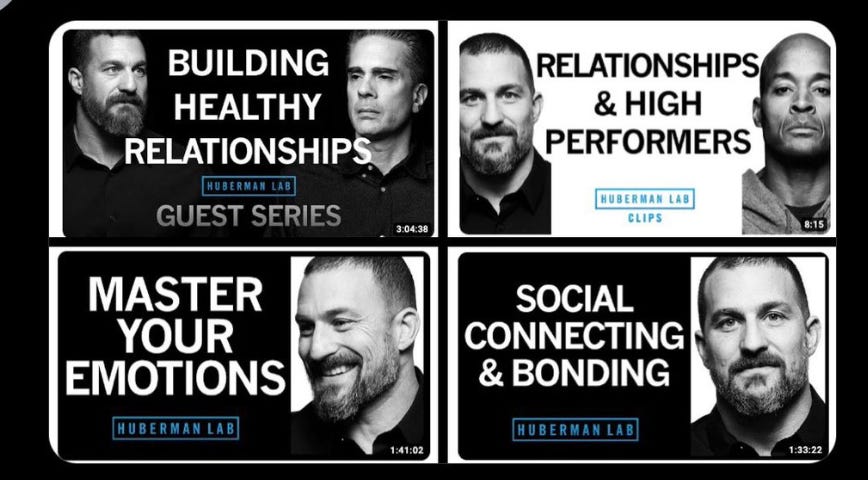
These are reasonable questions that were never really asked in the brief melee following the article’s publication. Reading through the comments attacking the New York Magazine was a slog, with fairly repetitive use of phrases like, “Ignore the haters”, “Congrats sir you’ve made it!”, or “I don’t follow him for relationship advice!”, that latter phrase being awfully ironic considering how often relationships are a topic of interest on the podcast (see screenshot below).
In sharing this, none of it should be interpreted as a repudiation of either Huberman’s work ethic or talent for presentation. I’m not even really interested in an analysis of the scientific rigor and quality of his podcast, and neither was the New York Magazine, summarizing those criticisms as follows:
His detractors note that Huberman extrapolates wildly from limited animal studies, posits certainty where there is ambiguity, and stumbles when he veers too far from his narrow realm of study, but even they will tend to admit that the podcast is an expansive, free (or, as he puts it, “zero-cost”) compendium of human knowledge.
From what I’ve listened to, that’s a fairly generous assessment, but if you’re interested in a more thorough and critical dissection, I’d suggest reading Dr. Andrea Love’s piece here.
As I said before, my argument is to point out that good science requires integrity, and it’s easy to see how. All scientific progress hinges upon honest reporting and accurate assessment of work previously completed. Most new medical treatments are not created from singular, independent efforts, but are the result of trying to advance previous practice. For example, physicians can now identify and treat prostate cancer cells in men with highly accurate precision and PET scan visualization. This breakthrough therapy is thanks to the work of scientists who discovered the PSMA, an antigen that is made by prostate cancer cells and can be traced in the human body. Such an advancement would not have been possible without honest and tightly-reported scientific work. In addition to foundational work, science requires reproducible efforts that allow us to verify one another’s findings and determine limitations. It’s just not a conceivable situation for scientists to say, “Just trust me” when asked to show their work. Failure to accurately report the biases and limitations, or worse, overhype the results can result in a misallocation of resources, funding, efforts, and trust from the people who rely on those findings.
Be it big or small, a breach of integrity is something you should always try to repair as soon as you can. The thing about those persistent breaches of integrity? At the end of the season, you reap what you sow. As many as 2,000 published articles have been retracted over the past 40 years, with the authors found guilty of misconduct ranging from selective reporting to data falsification. Just this year, the President of Harvard university resigned in disgrace over evidence of plagiarizing significant portions of her dissertation, though frankly, her failure to denounce calls for the genocide of Jews should have been enough to accomplish that.
Which brings us back neatly to those who defend Huberman’s conduct by claiming they’re just interested in his scientific explanations. Methodological explanations aside, he’s always going to recommend a course of action, is he not? Offer a prescription for how to “master yourself”? Do you trust that his recommendations are purely based on “the science”, and not some ulterior gain?
If you believe the answer is yes, or you believe that professional conduct is completely separate and impenetrable by the actions of your personal life, than perhaps you’ll find appeal in an alternative argument. It is that we need to encourage and live out the values we want to see in one another.
I do not want young men to look to Huberman and believe that the conduct of their personal life bears no consequences so long as they find success in their professional endeavors. I do not want women to believe that their value and unique mark upon this world lose significance because protecting a name became a higher priority. I want everyone to experience the power that is present in being the person you say you are, imperfections and all.
What is to be done about all this? I’ve spent time at length thinking about this last question, but I’m not really sure. I’m certainly not calling for any action against Huberman, as he is free to carry on in his business and life as he sees fit despite my objections to his impenitent misconduct. But maybe the next time someone’s moral failings are brought to light, we invest more in signaling the qualities we desire, and less on tribal defense because he’s “our guy”.
I suppose if I had the power to answer any single question in this entire unseemly event, it would be this — Does Huberman have anyone in his life who loves him enough to tell him, this was wrong? Can anyone in his social circle offer a sharp but compassionate reproof of his betrayals? I’m not looking for a wholesale dismissal and condemnation of a man, but I would like to see someone else who can denounce a specific action as wrong.
Ultimately, there may actually be a simpler response to the question, “Why does it matter though?”
It is this. What good is all that health if you have nobody to share it with? What good are the sciences, if there is rot and decay in the relationships we foster? If integrity matters for the workings of science, a process that is cold, unfeeling, and devoid of connection, than consider how much more it must matter for all of us in the lives we pursue and relationships we build.
Excellent, Dustin.